Here below, we gather growing advice for cultivating different varieties of summer flowers. Scroll down to find the variety you are looking for


Here below, we gather growing advice for cultivating different varieties of summer flowers. Scroll down to find the variety you are looking for
When to pre-cultivate and plant out
When is the best time to start sowing, it can sometimes feel a bit confusing. Sometimes you want to start early, but it can sometimes result in our plants staying indoors for too long and can then get too little light and be too hot so they become tall and lanky. In addition, they take up so much more space indoors if they have time to grow too big.
The time for sowing indoors that we have set for our seeds, is calculated on the last spring frost and when they can be planted out right where you live.
We all have different conditions and times when it comes to the last frost. We want our plants to be just the right size when it's time to plant out, which is when the chance of frost is over. At different weather stations you can see when the chance of the last spring frost is over right where you live. I usually check where it says 90% chance which is May 9th for me. So if something like should be sown 6 weeks before the last frost, so I can start sowing it around March 28. This is only an average, so sometimes you may have to wait another couple of weeks before planting out.
Good luck with the cultivation!
Zinnia
This wonderful summer flower blooms from about July until the first autumn frost! It is also an excellent flower for cutting and lasts a long time in a vase, and attracts pollinators! Who can be without Zinnia?
In our seed shop you will find about 20 different varieties to choose from. See the entire Zinnia range here!
Zinnia can either be sown indoors about 4-6 weeks before planting out and the risk of frost is over or it can be directly sown outdoors when it has become warmer. When sowing indoors, cover with plastic film with air holes, when the seed has started to germinate, remove the plastic and place in a bright and cool place.
Direct sowing should be watered daily to keep moist for germination. The disadvantage of direct sowing outdoors is that Zinnia is loved by snails so they get a bit of a head start when you pre-cultivate them. They germinate very quickly and after just a couple of days the sprout can look up. But they need warm soil to germinate, so you can expect a slightly later flowering when direct sowing.
If you pre-cultivate them indoors, plant them out 2-3 weeks after the last frost, as they do not like cold at all. They want at least 12-13 degrees at night, preferably up to 15. Zinnia can tolerate cooler temperatures but seems to grow more slowly in cooler than 12 degrees.
Zinnia also has sensitive roots and should preferably be re-cultivated as few times as possible. We recommend sowing them in soilblockers, where the roots are minimally disturbed. Sow them directly in Soilblocker Mini 4 or Mini 5.
If the plants are stressed or left in the same pot for too long and become root bound, it can result in double-flowering varieties producing single flowers for a period.
Zinnias can be topped and picked regularly for more flowering.

When do you know if your Zinnian is ready to harvest?
There are two ways to tell if your Zinnian is ready to harvest.

 Photo: Zinnia "Oklahoma Salmon" och Zinnia "Queen Lemon Peach"
Botanize among all Zinnia seeds here!
Cosmos
Sow indoors 4-6 weeks before planting out and the risk of frost is over. Cover with plastic wrap with air holes. When the seeds have started to germinate, remove the plastic and place in a bright and cool place. Do not sow Rosenskära too early as it can easily get too big before the weather is warm enough to plant out. When planting out, Cosmos likes to spread out and become bushy, so plant them 30-40 cm between the plants. Cosmos can also be sown directly when the soil has warmed up and the weather has become warmer.
Cosmos does not require fertilizer, as it can easily become too much foliage, which reduces flowering.
It is best to top off Rosenskära when it is 25-30 cm high, so it will branch out and become bushier. Harvest regularly and it will bloom all summer.
Vase life: Individual flowers last about 4-6 days, but each stem has multiple flowers that open over a week's time. Harvest when the flowers are just beginning to unfurl but have not fully opened to prevent insect pollination, which will help extend vase life by a few extra days.

 Photo: "Double Click Snow Puff"och "Cupcakes White"
Botanize among all Zinnia seeds here!
"Bells of Ireland" Molucella laevis
Suitable for sowing 6-8 weeks before the last frost.
"Bells of Ireland" can sometimes be difficult to germinate. We germinate them on a damp dishcloth and heating mat for best results. If it still does not germinate, we put it in a refrigerator. Cold-treating seeds is called stratification.
After a couple of weeks they usually germinate in the refrigerator. Place the germinating seeds on planting soil in a pot or plug tray.
"Bells of Ireland" is light-germinating, so just press them down against the moist soil, you can sprinkle a thin layer of Vermiculite over the germinated seeds to help retain moisture.


Sowing this way prevents you from having seeds left in soil that won't germinate!
Harvest when the flowers are half-open and pick regularly to encourage flowering and get more side shoots.
"Bells of Ireland" are also great to dry!


A tip when harvesting for a bouquet is to remove the leaves, so the beautiful bells stand out a little more, or if you want more filling, leave them on!


Photo top two: Fresh
Photo bottom two: Dried
Find seeds för "Bells of Ireland here!
Snapdragon
Snapdragon can be sown indoors 8-10 weeks before planting out and the risk of frost is over.
The seeds are light-germinating so they should only be pressed lightly against the moist soil surface, but can be covered lightly with Vermiculite. Sow them in a plug tray or start the seeds in the Soilblocker Micro 20 and then transplant them to the Soilblocker Mini 4.
It is advisable to top when it is about 10 cm to encourage the plant to branch, but topping the plant can delay the flowering time by a few weeks.
If it is topped, place the plants 30 cm apart.
Harvest when only the lower flowers are opening and no pollination has occurred, then it will last longer as a cut flower.


Photo: "Madame Butterfly Ivory" och "Cool Pink"
Botanize among all Zinnia seeds Snapdragons here!
Group 1-4
Snapdragons are sometimes divided into different groups depending on when they produce best, i.e. with long strong stems and flowering.
Here they are affected by the temperatures in which they produce best and how many daylight hours there are.
This is not something you have to follow when growing snapdragons, they will also flower outside these frames, but the groups are used especially in commercial cultivation, when you want to harvest them at their most productive time.
The groups are divided as follows:

Aster
Sow indoors 6-8 weeks before planting out and the risk of frost is over. Grows best at 20-22 degrees. Cover only lightly with soil or not at all, as the Aster needs light to germinate, or sprinkle a thin layer of vermiculite over the seed. This lets in light and gives the seed more even moisture during germination.
Keep the seed slightly moist at all times. Cover with plastic or similar with ventilation holes or ventilate frequently. When the seed has started to germinate, remove the plastic and place in a bright and cool place.
We think that the young plant will get better results if you do at least one transplantation during pre-cultivation and before planting out.
Plant out when the risk of night frost is over. The Aster wants a sunny growing location with well-drained soil.
Succession sowing is recommended for longer summer flowering, as the summer aster is considered a so-called "Semi-productive" variety, meaning the plant may produce several useful flowers but not at the same rate or quantity as a "cut and come again"


Photo: "Chrisantella Autumn Forest" och "Lady Coral Salmon"
Botanize among all Aster seeds here!
Sunflower
Sunflowers are easy to grow and loved by both bees and birds. They can be sown directly on the site or can be pre-sown 2-3 weeks before the last frost and transplanted. Direct sowing is recommended as the sunflower does not like root disturbance.
Sunflowers come in a wonderful variety of heights, colours and shapes.
Low varieties:
Great for pots, balconies or the front edge of a flower bed.
Branched varieties:
These sunflowers usually produce many smaller flowers per plant instead of a single large one. Great for cutting and if you want a longer flowering period on one and the same plant. Support may be necessary.
Single flowering varieties:
Usually produce only one large impressive flower at the top of a single sturdy stem. A so-called "one and done" sunflower that requires support in case of wind.
Feel free to grow the single sunflower in batches for a more continuous harvest.
We don't pinch this variety of sunflower!
Feel free to leave them standing at the end of summer for bird food in the fall.


Foto: Enkel sort "Pro Cut White Lite" och förgrenad sort "Claret"
Botanize among all Sunflower seeds here!
Lisianthus
Although Lisianthus is a perennial plant in its native habitat, they are most often grown as annuals.
Lisianthus seeds are very small, so they are often pelleted to make them easier to handle, but still quite small and round. A tip is to moisten a toothpick and lift up one seed at a time when you are going to sow them.
Sow indoors at least 12-13 weeks before planting out and the risk of frost is over. It is common for the seeds to take time to germinate and can also germinate unevenly.
The seeds are light-germinating so they should only be pressed lightly against the moist soil surface, so keep slightly moist at all times, not too wet but not too dry. Can be covered lightly with Vermiculite, to maintain a more even humidity. Cover with plastic or similar with ventilation holes or ventilate frequently.
When the seeds have started to germinate, remove the plastic and place in a bright and cool place.
Lisianthus thrive in warm conditions (cooler during plant growth), so it is recommended that they be grown in greenhouses. They like well-drained soil with lots of organic matter.
A challenge to sow, as they take time, so be patient!
Be careful with its delicate roots when transplant and make sure they don't become root bound.
The plants need support, such as a net support.
Harvest when one or more of the flowers on a stem have started to open.
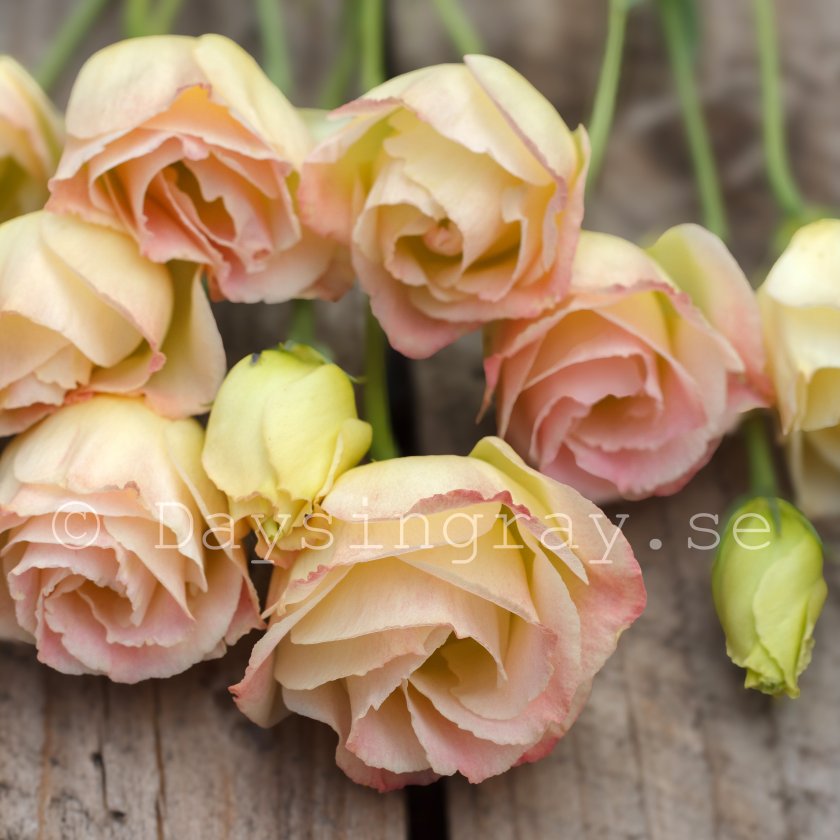
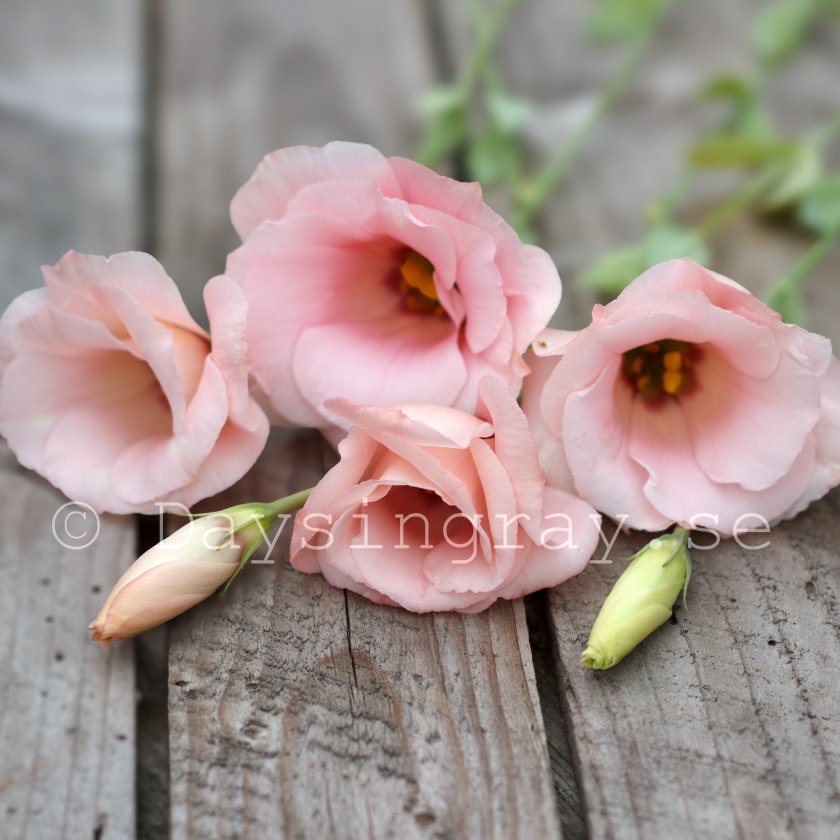
Photo: Lisianthus "Croma Champagne" and Lisianthus "Arena Apricot"
Botanize among all Lisianthus seeds here!
Group 1-4
Lisianthus is often divided into a group category from 1-4. The groups describe how the varieties react to temperature and day length during the establishment of seedlings and are mainly used in professional cultivation to control flowering time.
The group division shows how the varieties are used in professional cultivation, but does not limit what is possible in the home garden. All groups can be grown for summer flowering, the difference is mainly about how the varieties react to temperature during establishment and how sensitive they are at the start. Some varieties do better in cool weather at the start, while others tolerate heat better.
The groups are divided as follows for cultivation in the early stage:
Rosetting
If the Lisianthus plant forms a compact rosette and does not develop a stem and bloom, it is often because the temperature, light or watering was not optimal during the establishment. It can be too poor light, too high or too uneven temperature, or too much/too little water during the establishment.
Try lowering the temperature if possible to 10 C. degrees for 3-4 weeks, this will hopefully help the plant to break the rosette and continue growing towards flowering.
Larkspur
Sow in early spring indoors 6-8 weeks before the last frost, cover with plastic wrap with air holes. When the seeds have started to germinate, remove the plastic and place in a bright, cool place. Plant out while the weather is still cool.
Speed up germination by placing in the refrigerator for a week before sowing. (Stratification)
Can also be sown outdoors in the fall for earlier flowering the following year.
Tip: For longest vase life, harvest when ⅓ of the flowers are open on a stem.
To dry, allow all but the top three to four flowers to open, then pick and hang upside down in a warm, dry place out of bright light for 2 weeks.


The product has been added to your cart